Thursday, 20 October 2011

208 Theme1 Built Environment - Coleton Fishacre

Assignment 208 Principles of location photography Theme 1 Built Environment

11th October 2011 images taken while on a short break to South and East Devon.
Coleton Fishacre House Nr Kingswear Devon

Research, assignment planning and influences
I was visiting South Devon on a pre-arranged break and researched National Trust buildings in the area that would demonstrate how architectural styles have changed over time. This research was done with the aid of the Internet and the National Trust handbook.   
Coleton Fishacre House Nr Kingswear Devon was built in 1926 by Rupert D'oyly Carte, the architect was Oswald Milne who was an assistant to Sir Edwin Lutyens from 1902 to 1905. The building is in the Arts and Crafts style inspired by the positive simple designs of William Morris and Philip Webb.
I was influenced by the work of Val Corbett and Lance Wittenberg Professional Photographers whose work is shown elsewhere in this blog.

Choice of equipment, safe equipment operation and health & safety
To cover the possible photographs that I would be taking I took my Canon 350D camera, 18 to 50 mm zoom lens and a 70 to 300 mm zoom lens on this assignment. It was not possible to use a tripod for these images from a health & safety point of view as there were many other people around and a tripod would have been a hazard.

Choice of final images
The 6 images below were chosen from the 36 taken of the house on the day to reflect the age and style of the building.

Log of image capture
A view of the front of the house and entrance gateway.
Focal length 31 mm, set on manual exposure, ISO 100, 1/225 sec, f/7.1 

The rear of the house looking out over the gardens
Focal length 28 mm, set on manual exposure, ISO 100, 1/160 sec, f/4

The Loggia at the rear of the house used for informal dining.
Focal length 28 mm, set on manual exposure, ISO 100, 1/100 sec, f/4

Detail of the tall chimney characteristic of the Arts and Crafts style.
Focal length 29 mm, set on manual exposure, ISO 100, 1/250 sec, f/3.5


Detail of a archway leading to a courtyard with windows and a high roof typical of the architectural style.
Focal length 43 mm, set on manual exposure, ISO 100, 1/40 sec, f/7.1

Detail of a garden water feature with the balanced symmetry typical of the Arts and Crafts style.
Focal length 31 mm, set on manual exposure, ISO 100, 1/80 sec, f/7.1


208 Theme1 Built Environment - Buckland Abbey

Assignment 208 Principles of location photography Theme 1 Built Environment

10th October 2011 images taken while on a short break to South and East Devon.

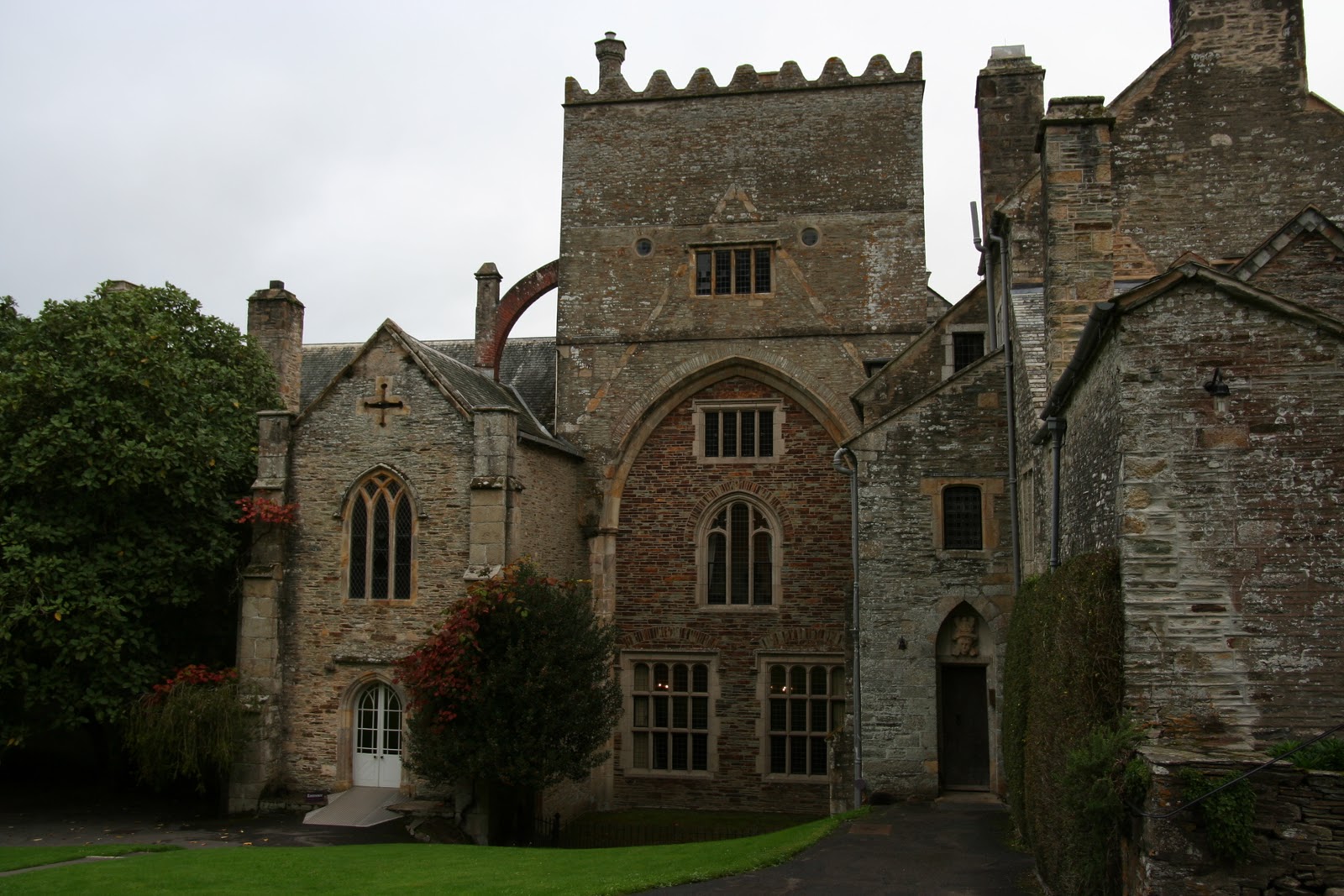
Buckland Abbey Nr Plymouth. 13th century Abbey converted to a house in the 16th century.

Research, assignment planning and influences

I was visiting South Devon on a pre-arranged break and researched National Trust buildings in the area that would demonstrate how architectural styles have changed over time. This research was done with the aid of the Internet and the National Trust handbook.  
Buckland Abbey was founded in 1278 by Cistercian monks. After the dissolution of the Abbey in 1539 it was converted into a home by Sir Richard Grenville who sold it to his cousin, Sir Francis Drake in 1581. After a fire and a subsequent restoration the Abbey is a mix of period rooms.
I was influenced by the work of Val Corbett, Lance Wittenberg and David Churchill Professional Photographers whose work is shown elsewhere in this blog.

Choice of equipment, safe equipment operation and health & safety
To cover the possible photographs that I would be taking I took my Canon 350D camera, 18 to 50 mm zoom lens and a 70 to 300 mm zoom lens on this assignment. It was not possible to use a tripod for these images from a health & safety point of view as there were many other people around and a tripod would have been a hazard.

Choice of final images
The 6 images below were chosen from the 32 taken of the house on the day to reflect the age and style of the building.

Log of image capture
Two views of the main building. 
 Focal length 20 mm, set on manual exposure, ISO 100, 1/80 sec, f/5

Focal length 28mm, set on manual exposure, ISO 100, 1/125 sec, f/2.8

A small doorway to the right of the main entrance with an interesting carving above. 
Focal length 33 mm, set on manual exposure, ISO 100, 1/60 sec, f/2.8

The interior of the great hall at Buckland. 
Focal length 21 mm, set on manual exposure, ISO 800, 1/40 sec, f/2.8

A barn that dates back to the original Abby. 
Focal length 21 mm, set on manual exposure, ISO 100, 1/80 sec, f/6.3

Interior of the above barn at Buckland
Focal length 18 mm, st on manual exposure, ISO 800, 1/60 sec, f/2.8


208 Theme1 Built Environment - Cotehele House

 Assignment 208 Principles of location photography
 
10th October 2011 images taken while on a short break to Cornwall, South and East Devon.

Cotehele House Nr Saltash, Cornwall. A 16th Century Manor House.

Research, assignment planning and influences

I was visiting South Devon and Cornwall on a pre-arranged break and researched National Trust buildings in the area that would demonstrate how architectural styles have changed over time. This research was done with the aid of the Internet and the National Trust handbook. 
Cotehele is a Tudor house with medieval origins. It is one of the least altered medieval houses in Britain. There have been very few changes to the structure since the improvements by Sir Richard Edgecumbe when the manor house was rebuilt between 1490 and 1520. 
I was influenced by the work of Val Corbett and Lance Wittenberg Professional Photographers whose work is shown elsewhere in this blog.

Choice of equipment, safe equipment operation and health & safety
To cover the possible photographs that I would be taking I took my Canon 350D camera, 18 to 50 mm zoom lens and a 70 to 300 mm zoom lens on this assignment. It was not possible to use a tripod for these images from a health & safety point of view as there were many other people around and a tripod would have been a hazard.

Choice of final images
The 7 images below were chosen from the 41 taken of the house on the day to reflect the age and style of the building.
Log of image capture

Front elevation of the house. 
Focal length 26 mm, set on manual exposure, ISO 100, 1/320 sec, f/5

Rear elevation of the house. 
Focal length 18 mm, set on manual exposure, ISO 100, 1/160 sec, f/5.6


Detail of a doorway window and stonework to the side of the house. 
Focal length 38 mm, set on manual exposure, ISO 100, 1/250 sec, f/5

Interior of the main hall. 
Focal length 38 mm, set on manual exposure, ISO 100, 1/250 sec, f/5

Interior view of the chapel within the house. 
Focal length 18 mm, set on manual exposure, ISO 800, 1/125 sec, f/3.5

Bedroom complete with original wall hangings and furniture. 
Focal length 18 mm, set on manual exposure, ISO 800, 1/20 sec, f/2.8

Detail of an original window with oak shutters. 
Focal length 26 mm, set on manual exposure, ISO 400, 1/60 sec, f/3.5


Equipment

Equipment available for Assignment 208 Themes 1 and 2.

I will be using an Canon 350D SLR digital camera because it will give me the flexibility to take the images that are required for this theme.

 
Lenses available:

Sigma 18-50 f/2.8 EX DC,


Sigma 55-200 f/4.5-5.6 DC,


Sigma 70-300 f/4-5.6 APO DG Macro


Accessories:


Tripod: Manfrotto 055 with a 3D head


Canon Remote Switch RS-60E3 (Cable Release) 


208 Theme 1 Built Environment - David Churchill Professional Photographer

Assignment 208 Principles of Location Photography Theme 1 Built Environment

Research and influences - David Churchill Professional Photographer

David Churchill is an award winning architectural photographer who has worked with many leading designers and construction companies. For this reason the majority of his work is of modern new and refurbished buildings. 

This is an unusual image as there is no focal point as such. The frame is divided into thirds by the brightly coloured window shutters and grey balconies. The long shadows have linked the balconies and the windows. By concentrating on this small part of the building the photographer has conveyed the style of architecture.

This is a striking image which shows the beautiful curves of the staircase that gives such good shadows and smooth textures. The blue glass and reflections help to draw the eye into the frame and then up the curve of the stairs.

This image is possibly to show the building next to the Nat West Tower in London and its position compared to the other buildings. The exposure has been well handled as some of the old buildings in the foreground are in shade and some in full sunlight. The textures, details and colours are also well controlled.

This is an image of a famous and iconic building by the architect le Corbusier called Villa Savoie. It has been photographed many thousands of times so this photographer has taken an unusual view of the building by showing just a small part of the house but revealing its style and rural setting. The exposure and detail is very good as there is a large tonal range from the white of the building to the black under the elevated section. The eye is drawn towards the dark window and the white round elevation on the roof which is the focal point.  

This is a very well exposed image to balance the light of the foreground interior with the window light in the background. All of the details, colours and textures can be seen. The eye is drawn through the doorway into to the room and to the blue lit window which is the focal point.

For this image the camera was at a lower level and looking up at the building due to the different levels of the ground of the surrounding area. The image is well composed with good detail, texture and colour. The photographer has included some of the dark green trees on the left of the building to balance the trees that are in front of the right hand end of the building. As the roof domes are very pale the focal point of the image is the central part of the building with the dark doorway. 

A different view of a famous building. The photographer has made the statue the main subject of the photograph but the eye is then led to the clock tower which has been placed just off the centre of the frame. Not all of the main Palace of Westminster building is in the frame but by using this view it is probable that many other distracting items have also been left out of the frame. The lighting, exposure is very good which has given excellent detail and tonal range to the image.

By framing this stark modern building with trees the photographer has softened the image but retained the impact of the building. The deep blue sky complements the colour of the building and there is very good detail, tonal range and texture. The eye is drawn around the curve of the building from left to right to the lighter part of the frame which is the focal point.

A striking image of an unusual building. If the frame had been filled with the building the decorative architectural structures on the roof may have dominated the building. By having some space around the building the image is more balanced. The highly saturated sky and foreground colours lift the image from a record shot of the building. There is very good detail, texture and tonal range in the photograph. The focal point and single vanishing point of perspective is the darker entrance at the centre of the building.

A well composed street scene where as much of the road and parked cars as possible have been cropped to concentrate on the fine buildings. The eye is drawn towards the domed building which is the focal point and the lighter lower sky line at the end of the street. The image shows good exposure, colour, contrast and tonal range. 


Thursday, 6 October 2011

208 Theme 1 Built Environment - Tutbury Church


Assignment 208 Principles of location photography Theme 1 Built Environment

28th September 2011

St Mary Church Tutbury

Assignment Planning
I photographed this church because it is 12th century with a very good example of a Norman arch doorway on the west end of the nave. 

Research and influences
This church was researched with the aid of the book England's Thousand Best Churches by Simon Jenkins. This book indicated that this was a very good example of a 12th century church. 
I was influenced by the work of Lance Wittenberg, Richard Southall and Paul Thetford Professional Photographers whose work is shown elsewhere in this blog.


Choice of equipment used
All of the images of St Mary, Tutbury were taken with a wide to standard lens, a Sigma 18 - 50 mm and with the aid of a tripod. I also had a 70 to 300 mm zoom lens available if required.

Health and Safety
It was possible to use a tripod because there were no people walking around the churchyard so the tripod did not create a health and safety issue. 

Log of image capture
This is a wide view of the church from the east end. It was difficult to obtain an image of the complete building as the churchyard is small so even with a 28 mm (35 mm equivalent) lens it was not easy to take an image that showed the size and proportions of this large church.    

Focal length 28mm, set on manual exposure, ISO 100, 1/50 sec, f/14

The great west arch at Tutbury
 Focal length 24mm, set on manual exposure, ISO 100, 1/200 sec, f/11

Details of the carvings on the great west arch
Focal length 38mm, set on manual exposure, ISO 100, 1/400 sec, f/11

Focal length 38mm, set on manual exposure, ISO 100, 1/250 sec, f/11

The south doorway arch at Tutbury
Focal length 28mm, set on manual exposure, ISO 100, 1/25 sec, f/20

Choice of final image 
Obtaining the right perspective of the church was not easy due to the small churchyard which made obtaining the right angle difficult. The west doorway was taken from the top of a earth bank that rises very close to the door. So the perspective is a little unusual as the viewpoint is well above the centre of the doorway arch.


208 Theme 2 Nature - Joe Cornish Professional Photographer

Assignment 208 Theme 2 Nature 
 
Research and influences - Images by Joe Cornish Professional Photographer

Joe was born in Exeter in 1958 and studied at Reading University. He moved to North Yorkshire in 1993 and now owns two galleries in Stokesley and Northallerton. He is a very well-known landscape photographer and has written or provided the images for many books. He has produced a significant amount of work for the National Trust. After working with 35mm and 6x6 film, since 1996 he has worked mainly with 5x4 cameras. In 1999 he set up the company Joegraphic to publish cards and calendars. Joe was made an honorary Fellow of the Royal Photographic Society in 2008. 

The first two images by Joe show how well he has used the light to convey the tranquillity of the scene. The colour combination of the warm glow from the sun and the blue reflections on the water. The patterns and lines give a good composition to the images and the rocks in the foreground give a very strong focal point. In both images the horizon is placed approximately on the top third of the frame and the portrait format rather than a conventional landscape format for this type of photograph may help to sell the image for use on a magazine front cover.


The image below has a beautiful range of colours and patterns produced by the composition of the buildings within the frame. The tonal range is very good with the brown, white and terracotta colours of the buildings balanced against the cool blue of the sea and sky.

A simple but very well taken image. Joe gets fantastic detail in all his photographs with the large format equipment that he uses. There are beautiful textures in the foreground rocks and a wide range of colours in the cliffs and there is a wide tonal range across the frame. 

Another strong simple image where less is more. The reflections in the deep blue water and equally deep blue sky give a exotic feel to an image that could have been taken anywhere. The eye is led across the water to the end of the headland which is the focal point. The headland across the middle of the frame and the square format makes the image very versatile as it can be cropped either way and there will still be a strong image.

This image was taken on a fantastic sunny day with a blue sky and small white clouds to add interest. Great detail, colour and textures in the rocks and the sea. The eye is led along the cliffs to the small rock at the end of the headland which is the focal point. The white lighthouse on the opposite site of the frame to the focal point may distract a little but the image probably works better with it than without or it would have been cropped out.

A beautiful sea and sky scape with some land silhouetted on the horizon to add to the interest in the image. The single focal vanishing point of the frame is the bright point of sky just above the horizon which is on the lower third of the frame. There is a full range of tones from almost white to black and a subtle range of blue, pink and gold.

An image probably from the 5x4 camera by the format that has a great detail and a wide range of tones and colours. This gives a strong image of rural Britain that could be cropped in many ways or left as it is to fulfil the need of picture editors. The eye is led from the larger tree in the bottom right foreground into the frame and towards the horizon. 

A well composed image, the focal point is the dark peak in the clouds. The eye is led to this from the heather in the foreground which is the only colour other than green and grey and then past the rocks in the middle distance. An image that conveys great mood and is very different from the tranquil image above.  

Another image with great composition and very good detail, tone, texture and colours. The eye is led into the frame on a zigzag from the highlighted rocks on the top left third down to the water in the middle distance and then on to the green hill and the brighter horizon.